Monday, August 20, 2012

A Woman's Hands

A mother's touch is legendary. We all envision delicate, petite, soft hands caressing a child's fevered brow.

Women's hands in modern advertising are always slender, smooth and have perfectly manicured nails. Men probably don't even really look at a woman's hands. My guess is that they are looking elsewhere, right men?

I have always had old hands. From the time I was a young teen I noticed that my hands were wrinkled and looked like they belonged on a 40-year-old woman. Because I am not terribly vain and really don't care, and because I have always worked with my hands, gardened, sewn, crocheted, cooked and subsequently washed up, I haven't really noticed my hands much over the years.

Yesterday I published a blog post on bread baking. Being the real person that I am, and not having a young hand model available, the hands in the photos on that blog post are mine. They are old. They are wrinkled. They have cuts, bruises, burns, callouses, and not-so-pretty nails. They are a working woman's hands. Sadly, they are not attractive hands. Yes, I noticed and vainly wished I had pretty, delicate hands for once in my life.

When I pull weeds I do not wear gloves. I own gloves and always attempt to use them but find that I cannot "feel" what I am doing so I end up casting them aside.

When I cook and wash dishes I do not wear gloves. I often use touch to determine if a pot is truly clean, if that hardened food on that plate is completely removed. When I sew, knit, put the battery charger clamps on my battery, check my oil, do laundry (often by hand), use a shovel or haul firewood I do not wear gloves.

My hands are often swollen, a side effect of my screwed up body after being infected with Lyme disease and who knows what else. When they aren't swollen they look even worse because they are so wrinkled they might as well be on the body of an 80-year-old.

You know what? That's okay. I have real hands. My hands do hard work. My hands pick berries and cucumbers from prickly vines. My hands are not on display for the pleasure of strangers. My hands are here to provide sustenance for my family. My hands bring great pleasure to my cats and dog.

On good days my hands are almost strong. On bad days they betray me. But they are still MY hands. They still do good.

Some days my hands shake. Some days my hands cannot even write a check. That's okay. They can still peel a potato or chop an onion. I think I might start photographing the hands of women. What a project that would be: a celebration of the work of women via their hands. Why not?

Sunday, August 19, 2012

The Baking of the Bread

I have been baking bread for over 30 years. It seemed like such a mysterious undertaking when I began in my run-down duplex in Austin, Texas on my used painted table. Imagine this: there was no internet yet. I had my Joy of Cooking cookbook only. Guess what? I taught myself how to bake bread using only that cookbook. The results weren't quite what they are now but it fed me and my son at the time.

A few years later I learned how to bake bread using a sourdough starter. That is a lot more complicated, though amazingly delicious if you have the time and energy. Definitely worth exploring after the basics of bread-baking are mastered.

If you have never baked bread ever then you are in for a treat. You will feel amazingly accomplished after baking your very own bread from scratch without corn syrup, xanthum gum, or genetically modified ingredients of any kind.

The following method is done completely by hand without the aid of any appliances. I have added notes for alternative use of appliances. Use whatever you enjoy, have time for, want to use. Who cares how the bread got made?

Whole Wheat Bread


Makes 2 loaves

2 cups plus 2 Tbsp warm water
Add 3-4 tsp dry yeast to warm water
Add 2 Tbsp raw honey or sugar
In a 4-cup measuring cup or bowl combine the following:

2 cups plus 2 Tbsp warm water
3-4 tsp dry yeast
2 Tbsp raw honey or organic sugar

Stir and allow to sit to activate the yeast and get it started.

In a large non-metallic bowl I put in the following ingredients:

3 cups of unbleached flour (organic, of course)
2 cups of whole wheat flour (organic, of course)
2 tsp salt

Whisk dry ingredients together. Nope, I don't sift.

Flour measuring is kind of tricky.  Make sure you fluff up or sift your flour before measuring. I fluff because I am lazy. I don't want to wash my sifter. Okay, that isn't true that I am lazy or I wouldn't be making bread from scratch. It hurts my hands terribly to use a sifter. It sounds cuter when I just say that I am too lazy to wash my sifter. But I digress.

Taking the 1 cup measuring cup, I put it into the flour and scoop and release over and over, fluffing the flour.  If the cup has a little more than 1 cup or a little less than 1 cup when you add it to the bowl that is okay. It really doesn't matter much.

Proofed yeast mixture

Putting it all together


Pour water/yeast/sugar mixture into dry ingredients.

Add 2 Tbsp fat of your choice (olive oil, coconut oil, I have even used lard).

Stir with a good-quality wooden spoon. I prefer my shorter bamboo spoon.

If the mixture is too dry to stir easily add 1 Tbsp water at a time until it is very sticky.

At this stage of bread making your goal is to develop the gluten which creates the structure necessary to hold the carbon dioxide gas the yeast organisms will create causing your dough to rise. Gluten develops as it is rubbed, moved, handled. You do not need a heavy hand during this process. As a matter of fact, there are bread makers (human kind) who don't knead at all, they just stir, allow to rise several times, gently stretching between risings. I have done it both ways and prefer my method because it takes less of my time and attention.

If I am tired, I actually sit down in front of the tv or computer with the bowl and stir for a few minutes off and on. I stir about 10 times let it sit, stir 10 more times, take a break -- I have weakness in my arms so I take my time. You just want to develop the gluten a bit. If you are able-bodied you can get this stage done in 2-3 minutes of stirring in the kitchen, or use your mixer with a dough hook.

If you have a bread maker you can use it for this entire stage and even the rising stage, then remove to form the loaves or rolls.  I don't like the big hole the bread maker leaves in a loaf of bread so when my bread maker worked I just used it to mix, knead and rise. I also noticed that the loaves were much tougher than my handmade bread. 


Kneading and Forming the Dough


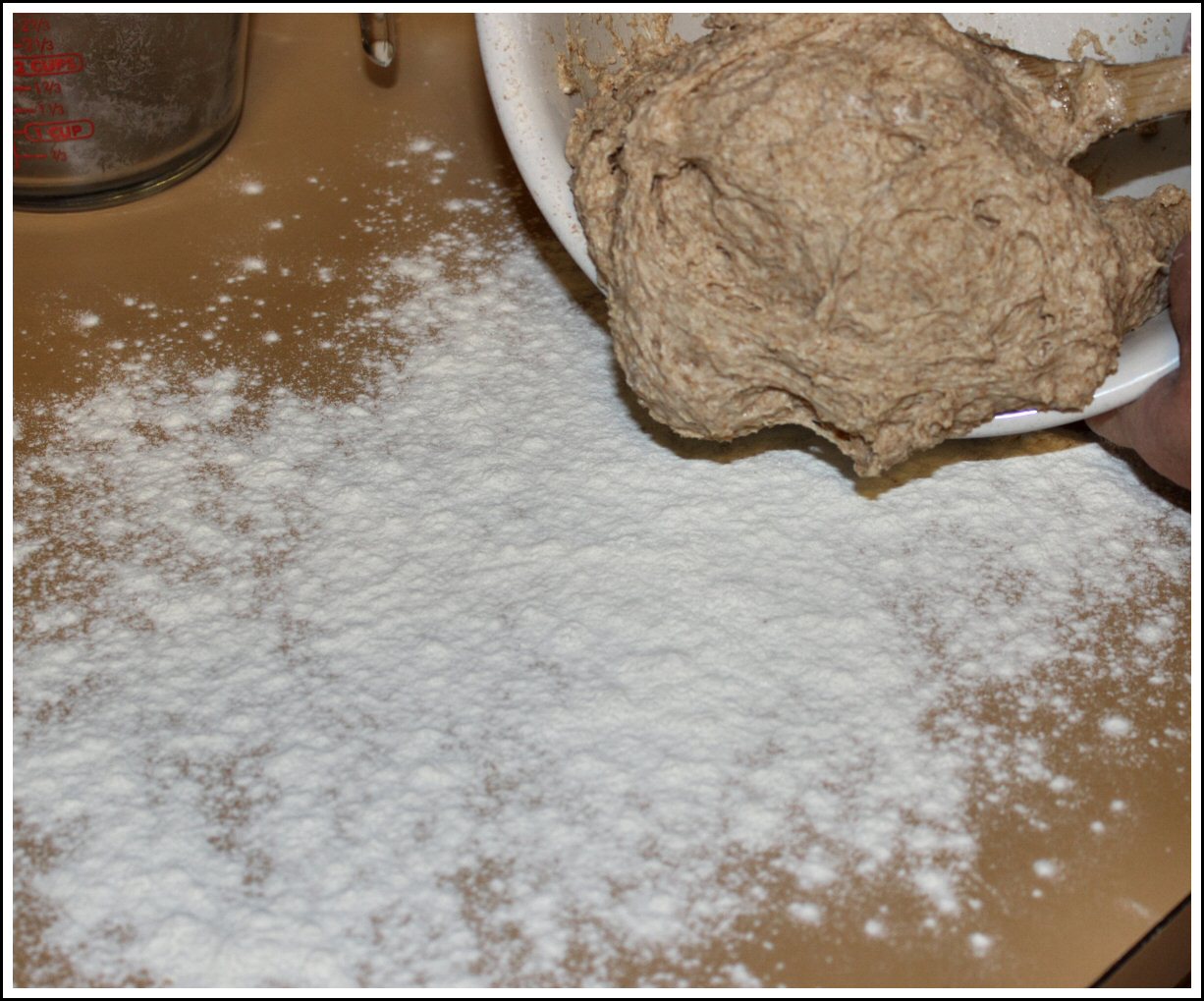
After the dough is very stretchy and you can tell the gluten has developed enough (it is very, very difficult to stir), dump the dough onto a floured surface, either a countertop or large wooden cutting board.

Add more flour until you can handle it with floured hands and not have the dough stick to your hands (it will still be a little bit sticky but not too bad).

Knead the dough for a couple of minutes continuing to add flour. The goal is to end up with approximately 3 cups of whole wheat flour total but you are looking more for a consistency, not an amount of flour.

Pour a Tbsp of oil in the bowl, put the dough ball back in the bowl, flip it so the top and bottom of dough ball are oiled.

Cover with waxed paper or plastic wrap and a kitchen towel. The plastic wrap keeps the bread moist and the towel helps retain warmth which is necessary for the rising process.
I place my dough in a warm place in my kitchen to rise. Keep out of cool drafts. Near a coffee pot, in the corner on a counter on the stove side, even beside the refrigerator are good places. I like to make bread when I have a pot of something cooking on the stove. A warm kitchen makes the rising process go faster.
Allow the covered dough to rise for an hour or so until the dough is at least doubled in size.
I have read that it should bounce back when you press down with your finger. Really, it isn't that complicated. A little less rising, a little more rising. It doesn't really matter that much for family bread baking. We are not going gourmet here, at least I'm not. Your family, partner, spouse will absolutely love you for that amazing smell you are filling the house with and that fresh-baked bread taste, hot from the oven experience.
If you want you can start your bread at night and put the bowl in the fridge to slow rise overnight.  Remove from fridge and allow to come to room temperature before continuing.
Putting the waxed paper or plastic wrap aside to reuse later, flour your hands and punch down the dough. This gets the majority of the air bubbles out of the dough.

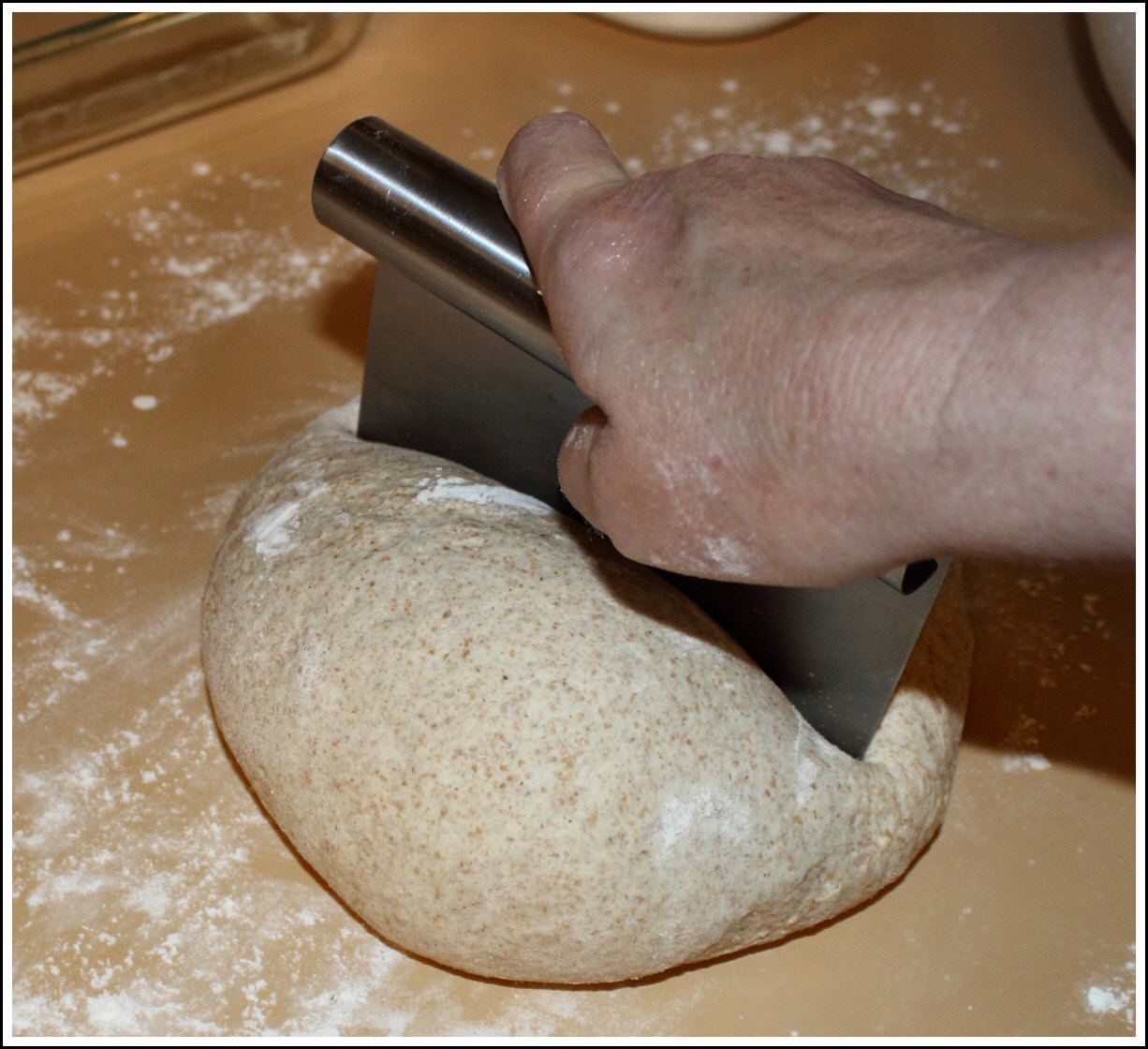
Knead for a minute or two on a floured board. You are getting ther est of the air bubbles out and developing the gluten a little more for the final rising. You should not need to add any more flour at this stage. The dough will be fairly smooth though not as smooth as white bread dough.

Divide the dough in half.

Forming the Loaves


There are many methods for forming loaves for baking. I lean towards what is fastest and easiest.

For long loaves, I keep folding the long sides into itself as the loaf gets longer then fold the ends in a couple of inches. You want your dough to be the length of the baking dish or pan.

Forming a loaf pan shape you can tri-fold or roll it out and then roll it up similar to a jelly roll shape.

Place both loaves in a greased 9x13 glass baking dish or individual loaf pans.

My new favorites are two long loaves in the 9x13 pan. Bakes so fast, versatile size for sandwiches or garlic bread, and looks so lovely, artisan-like.

Brush the top of the dough with olive oil or butter, or spray using a non-GMO baking spray which means no canola.
I found an organic olive oil baking spray at my grocery store or you can buy spritzer bottles designed for oils.
Cover with the waxed paper or plastic wrap you used in the first rising then with a kitchen towel and allow to rise a second time.

I preheat the oven to 400 degrees about 30 minutes after the start of the second rising. The heat from the oven helps the dough to rise quicker.

Bake at 400 degrees F for 30-35 minutes.

Remove from pan immediately and allow to cool on it's side if it was baked in a loaf pan or on its bottom if baked in the 9x13 (I pull the two loaves apart to cool) for 10-15 minutes before slicing if you want warm bread. Cool completely if you want sliced bread for later.

Brush the loaves with melted butter or olive oil for a softer crust, or leave as is for a harder crust.

I like the long loaves which make smaller sandwiches. These two loaves don't last 24 hours in my household.

If you are not going to use the bread immediately you can double wrap/bag and freeze. You can also slice and then freeze if you like, even freeze a few slices in sandwich bags for making school lunches (reuse the storage bags for the sandwiches). The frozen bread defrosts as it helps keep the sandwich refrigerated until lunch.

Well, you did it! This recipe can be used for rolls, fried bread, even flatbread (without the second rising). This is just the beginning. The world of bread baking is enormous and full of adventure. And don't forget sourdough.
Enjoy!

Friday, August 17, 2012

Deck Garden and Pests

Eclectic Deck Garden


My deck garden is changing and growing and evolving every day.  Along with a place where we hang out laundry (I have two 40-foot clotheslines that are accessed via my 2nd story deck), and grill the hamburgers, and occasionally shoot targets, and watch for deer and coyotes, and look at the night sky, and . . . I am starting seeds and growing tomatoes, peppers, and weeds.

Yes, I am growing weeds.

Cultivating Weeds

One of my recent interests, among many others, is foraging for wild edibles.  I am a neophyte for sure.  A few months ago I knew that dandelions were edible.  That's it.

Today I know that lambs quarters, wild strawberries, purslane, milkweed, Japanese knotweed, plantain (the kind that grows in my lawn, not the banana lookalike), cattails, autumn olive, and many more are all edible and grow on my property (except for the cattails which I hope to remedy soon).

I used my goat house compost for potting soil in all of my deck garden containers.  I have pulled many weeds out of those containers.  One weed I have allowed to grow in my bell pepper plant's container: purslane.

Purslane can be used in salads, soups, and pestos, and is reputed to have a spicy flavor. 

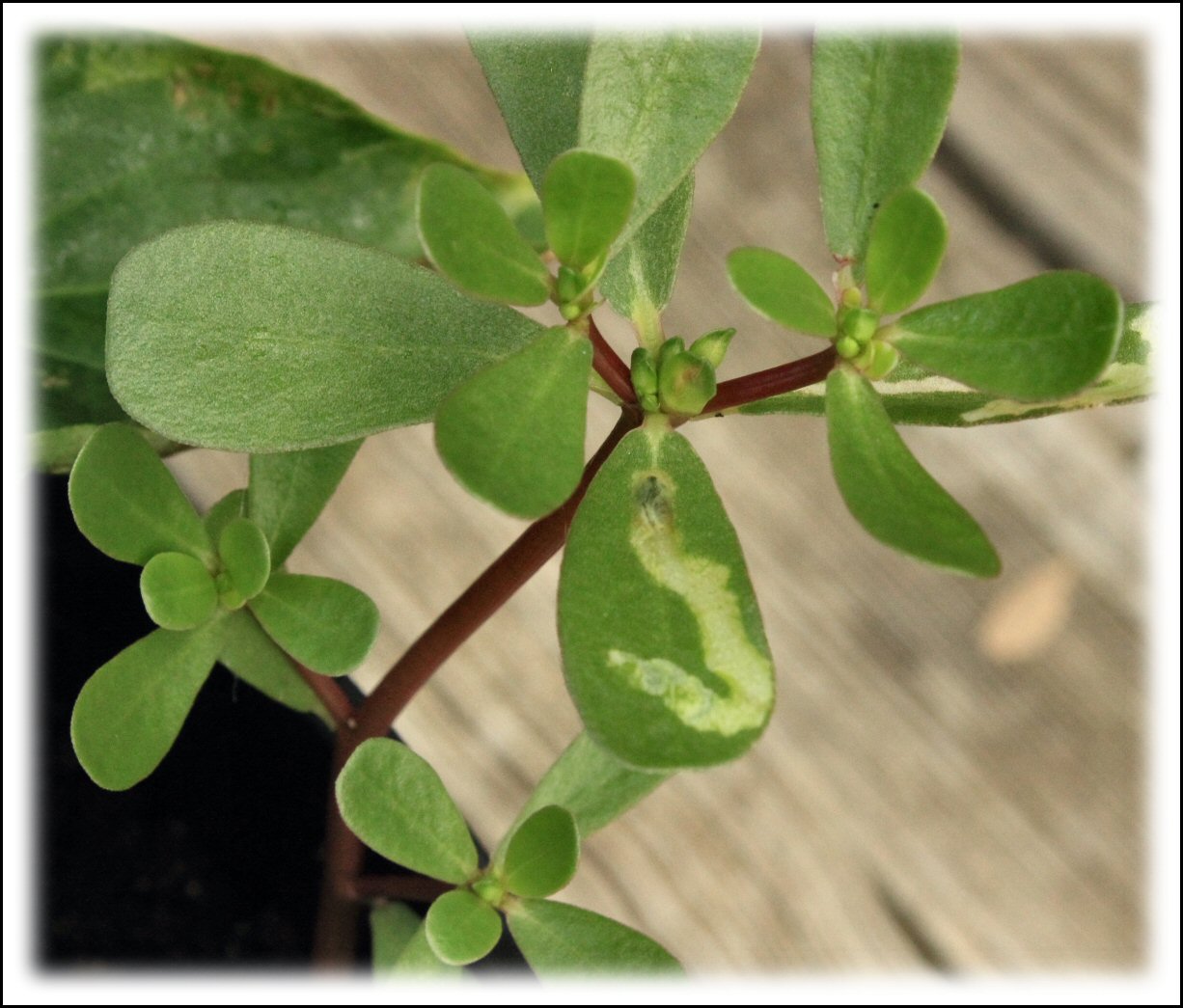
The picture to the left shows a leaf miner larva chowing down on my purslane.  I picked off each of the leaves that was damaged and threw them away.  These pests can do a lot of damage.  I will need to check each day for new damage.

Leaf miners are larva of flies, moths, even beetles that eat the fleshy part of leaves.  This protects them from predators, giving them a safe place to chow down.  After taking this picture I noticed that my purslane is forming buds.  I will collect some seeds to sow next spring, or maybe even this winter indoors.

Fall Seedlings


In pot number 1 I have from top and going clockwise Snow Pea (2 o'clock), bell pepper (4 o'clock), and the rest Calabrese Broccoli.  I planted a couple more Snow Pea seeds yesterday so that I have at least 4 and hoping for 6 plants going into the cooler weather.

The broccoli seedlings are ready to be replanted in larger pots.

I suspect the bell pepper plant will not have time to do much of anything before it gets too cold but I might bring it inside and provide a grow light for some of my plants; my real wish is for a small greenhouse on my deck.  Oh, if only.

In pot number 2 from the top we have two Snow Peas (11 and 2 o'clock), three Jalapeno pepper plants (5, 7 and 8 o'clock), and in the center Bok Choi seedlings.

My 19yo son and I went shopping on Wednesday and treated ourselves to a Chinese buffet.  Of course, I had to taste every vegetable in that buffet.  I was so excited to find steamed Bok Choi leaves with the crunchy bottom part and green leafy part intact.  So now I am really excited about my Bok Choi.  I will make this crop succeed somehow.

The Jalapeno pepper plants are for my boys.  I prefer sweet peppers but they really like that heat.  Again, started way too late most likely but I will do what I can.  Still want that greenhouse.  There must be a way!

Bell peppers and purslane
Baby bell peppers growing
Bell peppers and purslane
I believe these are Moskovich tomatoes

San Marzano plum tomato

Moskovich tomato, I believe
 Although my garden tomatoes are all still going strong I think I will be able to extend my tomato harvest with these container-grown tomatoes.  I was hoping one of them would be the yellow pear cherry tomato but alas, not to be.  Those turned out to be the most delicious, sweetest cherry tomatoes out of all the varieties I grew this year.

Now to find some giveaway pots from someplace so I can replant my Bok Choi and Calabrese Broccoli seedlings.  Wish me luck!

Thursday, August 16, 2012

Exploring Connecticut - Chester-Hadlyme Ferry Part 1

In 1769 John Warner built a ferry that traversed the Connecticut River between Chester on the west side and Hadlyme on the east side.

More than 100 years earlier two ferries had been built, one in 1662 to the south between Old Saybrook and Old Lyme and the other several miles upstream in 1664 between Haddam and East Haddam.

Warner's Ferry later carted supplies across the Connecticut River during the American Revolution which was a flat-bottomed scow powered by men using long poles.  I can only imagine who and what used that ferry during that period.

Essex-Lyme Ferry
- Essex Historical Society and the Treasures of Connecticut Libraries
A steam-powered ferry was put in service around 1877.  I could find no photos of any of the historical Chester-Hadlyme ferries, unfortunately.

The Essex Lyme Ferry pictured left gives us an idea of ferry construction in the late 1700's.  If time travel were possible I would love to spend a few weeks in Connecticut during this time period. 

Ferry Boats a Way of Life in Early Connecticut

Today, the Chester-Hadlyme Ferry still provides an important service.  Those of us who live in this area know that there are limited ways to cross the Connecticut River.  Far to the north in Middletown-Portland is the Arrigoni Bridge and far to the south is the Old Lyme Bridge.

One evening as I was returning from Old Saybrook, I arrived at the East Haddam Swing Bridge area and a long line of cars.  This is not unusual as it takes about 10 minutes for the bridge to open and close resulting in long lines of cars on both sides of the Connecticut River.  On this day, however, the bridge did not reopen.

I was actually able to see the bridge from where I stopped and could see smoke and a boat beneath.  My daughter and I decided to have dinner at Haddam Pizza while we waited for the bridge to be repaired and reopen but as time went on, dinner was finished, the bridge did not reopen.

Chester-Hadlyme Ferry
Our choices were 18 miles to the north, 20 miles to the south or the Chester-Hadlyme Ferry.  Because I had waited so long the ferry had a long line as well so we just drove down to Old Saybrook, got on I-95 and crossed in Old Lyme then headed back up on Route 156.

One time years before the bridge was closed for some unknown reason and because I had a car full of young children I immediately drove down to the Chester-Hadlyme Ferry.  Within minutes there was a long line of cars behind me.  For $3.00 we crossed the Connecticut River in our mini-van.  It was my first and only ferry crossing.

The State of Connecticut threatened to close the ferry permanently in 2011 due to budget cuts, but the uproar of opposition stopped that plan.  Really, find somewhere else to cut costs.  Removing one of only three ways to cross the Connecticut River in a 40-mile range is just silly.

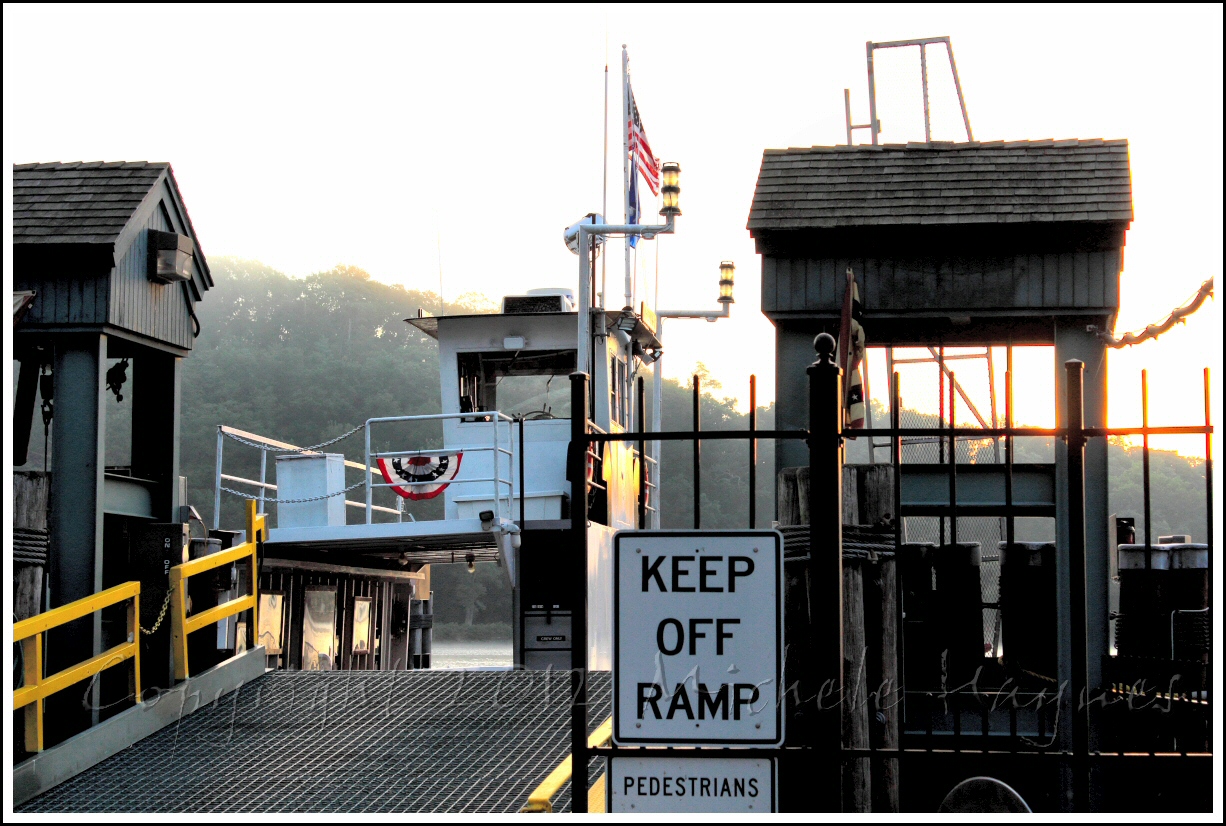
Sunrise at Chester-Hadlyme Ferry on Connecticut River
I plan to photograph the east side of the Chester-Hadlyme Ferry at sunset next time. Stay tuned.

Wednesday, August 15, 2012

Being a Cheerleader

Chester-Hadlyme Ferry at Sunrise -- Connecticut River
I sat down prepared to create a post with some of the photos I took yesterday at the Chester Ferry.  I love sunrise.  It is so quiet.  It is soft.  It is relaxing.  I wanted to share that mood, that feeling with all of you.

But then I saw a Facebook friend posted something that said this:

Student says,  "I am very discouraged.  What should I do?"

Master says,  "Encourage others."

Then I knew what I wanted to write about today: my apparent purpose in life, at least for now.

I am chronically ill.  I cannot work (at a real job making real money -- you know, like drive somewhere, perform tasks for money, drive home and perform tasks for no money).

I struggled with feeling useless for a long time.  I did work part-time for nearly a year a couple of years ago but it completely drained me leaving me with absolutely no energy to care for my family.  And I am the only caregiver of my family.  I am the only one here day after day, involved, caring for my children, adult and minor alike.

Many of you know that I have children with labels.  Some of those labels include ADHD, bipolar disorder, borderline Asperger's Syndrome, depression, even physical illness.  Some of the other labels include genius, brilliant, creative, innovative, and special. 

Living with labels means that nothing is simple.  Nothing is easy.  Nothing goes smoothly around here.  

Living with geniuses means that nothing is simple.  Nothing is easy.  Nothing goes smoothly around here.  

Yep, those good and bad labels produce similar circumstances, an atmosphere of challenge, so to speak.  Or maybe I should say "positive" and "negative" labels.  Lots of people would love to have a child with a genius IQ.  Many parents start pumping that grey matter to inflate its capability starting when their children are babes in arms.  No parents wish their children were ADHD, bi-polar or Autistic.  

Parenting children like mine has molded me.  When I was younger I often bordered on the morose, so completely introspective, so withdrawn.  I saw a lot of darkness.  I didn't see a lot of light.  I knew it was there, though.  I remember finding good in nature, literature, and creativity when life was not so nice.  I have always had this capability.  I am an independent soul who enjoys isolation, thinking my own thoughts, and yes, doing my own thing.  

And then I had children.

Children demand our whole beings pay attention to them.  Usually we embrace this new paradigm for life, one in which the self goes to the back seat while the self-less emerges dominant.  Most of the time we do not complain (okay, sometimes at 3 in the morning when a teething baby was in pain and making her discomfort known so emphatically I complained a little).  As time goes on we are molded by our parenting duties.  We are molded into different people by the needs of our offspring.  

When those children have "special needs" this molding moves to a whole different level.  Those around us also mold us.  They often push us away.  We must be bad parents.  We must be doing something wrong.  We must have bad dna.  Whatever.  Isolation becomes a safe place.

Then something miraculous happens:  we meet other parents of other challenging children.  We begin to share stories.  We begin to open up a little.  We find that sometimes it is safe to be a parent of challenging children around others.  We also learn how to support our children while we are, for the first time, receiving support from others (yes, parenting a special needs child is not easy -- in case you didn't know).

I have been parenting for 35 years now.  Whew!  That is a long time.  And I am still parenting.  Not the 35-year-old: he has life figured out for himself, his wife and his daughter (as much as we can ever figure out life).  But I am still very involved in the lives of the other five ages 22, 20, 19, 16 and 12.  

When one of my children becomes absolutely and completely discouraged I become their cheerleader.

"You can do it!"

"Yes, you can!"

"You can do it!"

"I know you can!!!"

In the case of bipolar disorder discouraged can quickly spiral into suicidal.  Being a cheerleader in the life of a bipolar person reaches an entirely different level.  

In the case of someone with Asperger's Syndrome being a cheerleader usually means encouraging them to keep learning those pesky social skills.  I am not the best myself in the area of social skills.  I would rather not even need them.  Just leave me alone to think, write, take pictures, be creative.  But I do understand them and can use them when necessary. 

Parenting a musical genius who is chronically ill is my greatest challenge right now.  I am not doing very well at this point.  I am trying, though, and constantly reassess my skills and abilities.

I am not a warm and fuzzy mom after the kids reach a certain age.  I am more of a "get it together and grow up!" kind of person.  Yes, it is true.  I hang my head in shame sometimes at my lack of mothering instincts once kids reach the teenager years, but I have been raising five boys for a long, long time, and they do not invite warm and fuzzy.  [I did live with a lot of criticism of my parenting abilities throughout my marriage which I believe affected my mothering instincts, sadly.] My job is to teach my children to be independent, strong people who can handle anything life throws at them.  This is not a warm and fuzzy job.  It is, however, a job for a cheerleader!

I don't tell my adult children what to do.  I do try to encourage them to find solutions to life's problems.  One thing my children know: I love them and I am there for them.  Sometimes I do throw a little tough love at them, and sometimes I pull away a little, like letting go of your children when they are learning to ride a bike, and let them flounder a bit.  They might feel as though I don't care but the absolute opposite is true.  I care so much it hurts.  I cry for my children.  They don't see me cry, but I do.  Their struggles threaten to destroy me sometimes I feel their pain so deeply within me.  Sometimes Mama Bear mode kicks in and I could scratch out the eyes of anyone who threatens my babies, though this is an internal struggle, not one that materializes or is even obvious to those around me.

My children have not had it easy.  They have had it real hard as a matter of fact.  The last 6 years have been brutal. Many of the adults in their lives have let them down.  

Each morning I wake up it starts with a new day of cheering one after another of my children on.  And I have come to accept this as my role, as my purpose right now.  And you know what? That's okay.  I'm okay with that. 


Monday, August 13, 2012

Food has become precious

19yo working on new firewood storage base
Something has happened to me and my children over the past few months.  We have learned how very precious food is to us.

Because of circumstances beyond my control my food budget has been reduced to about $400 a month. USAA recently reported that the average monthly food costs for a family of four (two adults and two children) is over $1000 a month.  I live in one of the more expensive places for food.

We have learned to appreciate food.  Corresponding to a small food budget I have become aware of GMO's (genetically modified organisms) in the US food supply.  They are everywhere and would require at least three separate posts to explain.  Suffice it to say that since my 16yo and I have been ill for a long time now with no medical help from the medical community in sight, I am looking to lifestyle, diet, environment for answers.  I am trying to avoid GMO ingredients.

Homemade whole wheat flatbread
This leaves us with plain food.  Nothing that comes from a box.  Okay, we can maybe eat pasta but we aren't really even eating much of that.  What do we eat?

  • Organic dairy products such as yogurt and milk
  • Organic grains such as oatmeal and flour which we cook from scratch into hot cereal and breads
  • Fresh local fruits and vegetables, some grown in my own garden
  • Fresh meat cooked into meals from scratch or preserved
  • Plenty of good fats (lard, olive oil, butter)
  • Homemade salad dressings and marinades
  • Scratch desserts
Our pantry and refrigerator look virtually empty.  My kids balked and complained at first.  My 16yo, who is already very skinny lost 16 pounds (he has since gained this back).  My 19yo has slimmed down quite a bit.  My 12yo and I are losing weight.  If we are hungry we grab a fresh peach or slice up a home-grown cucumber and eat that.  The boys make single bowls of organic oatmeal at least once a day for breakfast or a snack.  We eat a lot of eggs and cheese and yogurt.  We eat a lot of vegetarian meals.  We have organic popcorn for snacks. 

My first garden in years has been fairly successful but has not provided a lot of food for the size of this family.  My kids love veggies so there are never enough.  The main problem with my garden spaces was a lack of sun.  They got between 6-8 hours a day when they needed at least 12-14.  We were going to take down some trees around the perimeter of the yard but the chainsaw broke with no funds to replace it.  We made do.

If I am still here next year those trees are coming down.  It is a necessity.  The secondary reason for the trees is that we have a wood boiler in this house.  It is connected to and right beside the oil boiler and heats the house and our water using wood.  I wanted those trees for firewood to heat the house and save money on heating oil which has become outrageous at $3.49-3.79 a gallon. 

So here I am with a single zucchini that took me 2 months to grow and I need to feed four people.  That zucchini is mighty precious.  I feel like bronzing it, to be honest.  I know how much work that single zucchini was for me and my kids.  My 19yo dug that front yard garden for me this year.  He knows how precious that zucchini is to all of us. 

What do you do with a single zucchini?  You start by slicing an onion and green pepper you bought at the farmer's market from a local independent farmer.  Throw those in the big cast iron skillet with a spoonful of lard and start them sauteeing.  Then I slice that most amazing, precious zucchini along with a yellow squash I bought from that same local independent farmer at the farmer's market and throw those in the pan.  I sprinkle the whole mess with a little salt and cook until the squash is just barely tender.  I serve my most precious zucchini and other veggies over organic brown rice (that took 50 minutes to cook).  I watch as my kids moan in delight at the flavors that they never knew until this summer.  Food has become precious to them. 

They are tasting real food without all of the additives, preservatives and sprayed on vitamins.  They help me pick out those fruits and vegetables from the farmer's market stand.  They carry those heavy treasures because there are no shopping baskets at the farmer's market.  You use your own muscle power to carry your food.  They help me bring the foods into the house and oftentimes help me prepare them.  They see me mix up a batch of bread or stand over the stove for an hour making fresh tortillas.  They see that pot of black beans on the stove all day long.  They smell it cooking and can't wait to taste it. 

They have helped with the garden and seen how much work it is to grow food.  When we get one cucumber at a time that cucumber has to be divided up and shared among four people.  You don't get a lot of food sometimes.  You certainly don't have food that you just grab out of a bag or box and stuff your face with mindlessly.  When they are lucky there is homemade jerky in the pantry or fridge for a quick protein snack.  But not always.

My children are not starving.  Actually, I think they are getting much more nutrition now that we have a lot less food.  Because what they eat is packed with natural nutrition, not added, sprayed on or "enriched".

We still get the occasional take-out Chinese (last time 19yo treated us) or pizza (22yo treated us on Saturday).  And we really enjoy those meals.  But even those foods are more precious to us. 

Even though this journey hasn't been fun, and our stomachs growl sometimes (mostly because we are too lazy to go make something that we know will take time), I think we are much better off now than before.  We certainly appreciate good food, real food, nutritious food.  Food is so very precious to us now.


Lazy Days -- we all need them

Yesterday I overdid.  I awakened around 4:30 a.m. but stayed in bed until 5:30 a.m.  I took photos in the morning, came home and processed some of them, then ran out to the farmer's market.  I always park away from the maddening crowd when I go there; just a short walk, but a walk, nonetheless.  Since The Local Beet food co-op is right there I picked up a few items.  Why was everything I bought yesterday heavy? Three-pound jar of raw honey, two pounds of peaches, three pounds of onions, a pound of bulk brown rice, two dozen cage-free eggs (those eggs never had to live in a cage EVER). 

When I was done I realized that I had to walk back to my car a few blocks away.  Next time I will insist one of the boys come with me.  I sure could have used their muscle.  I made it to my car then had to stop by the market for something for dinner.  Picked up a cheap cut of London broil, and I am on my way home.

I know it doesn't sound like much, but that was just too much for one day and my body started protesting. 


When I got home I needed to slice and marinade the meat.  Done.  For a late lunch I put on a pot of rice to cook while I started sauteeing vegetables.  Then I started a batch of bread for steak sandwiches.

Rice and veggies all done we chowed down.  My 16yo asked me what I put in the rice after saying how delicious it was.  "Salt," I responded.  We both laughed and enjoyed our lunches: sauteed onions, green peppers, zucchini and yellow squash over brown rice.  Yummy. 

I got a little break while the bread was rising so I knitted and watched Heroes on Netflix.  I started sliced onions in the skillet for steak sandwiches (I prefer the slow carmelization method -- lard, onions, med-low heat for about 30 minutes).  I was so tired at this point that I assigned stirring onion duty to 16yo.  I divided and formed my two loaves of bread and put them in my 9x13 glass baking dish.  This is my new favorite way to bake bread.  It makes two long, lower loaves resulting in smaller slices of bread for sandwiches and garlic bread.  I baked them for 35 minutes at 400 degrees F. 

As soon as the bread came out of the oven I threw the steak in the pan and cooked on high heat for a couple of minutes.  I took the meat out of the pan, allowed the water from the marinade to evaporate and threw the meat back in for a quick brown.

Dinner was served: steak, sauteed onions on homemade bread.  Oh, we had snacked on cucumbers before dinner so we didn't have a separate veggie dish.  There were no complaints.  I was asleep in the chair by 7 pm.  I tried to stay up later but finally dragged myself to bed at 8:05 pm. 

Today I need a rest so it is a declared lazy day.